My students studied comparing in math using greater than, less than, and equal to at the beginning on the year. I wanted to see if they still knew it. They did a great job!

Tuesday, April 21, 2015

Telling time WBT video
My students studied telling time almost a month ago. Whenever we learned a new part of telling time, they learned a new part of our saying. They did a great job remembering it!
Ch 5-7 points
I'm excited to share my points from WBT ch 5-7 assignments!!! I'm moving on up in the Whole Brain world.



Monday, April 20, 2015
Ch7 assignment
Chapter 7: Five, Powerful Classroom Rules
Describe how you will teach, and continue to reinvigorate for the school year, one of the Five Classroom Rules.
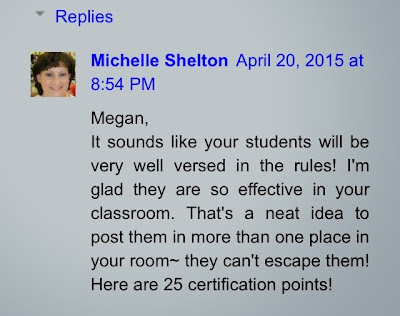
I believe all Five Classroom Rules are equally important. I begin teaching my students the Five Rules when they arrive on the first day. The first thing I teach them when they come in is “class-yes.” Then I follow that with “mirror-words” and “teach-okay.” Once they have a grasp on those three WBT techniques, I then begin teaching the rules. I have my rules posted on all four wall. That way no one can say, “I didn't know what the rules were.” So, to teach the rules, I give the “class-yes” attention getter, then call for “mirror-words,” and finally I give the rule number and gesture at the same time. I then give the call “teach-okay,” and the students use big gestures to teach their partner. Once both partners have had a chance to teach, I call “class-yes”, and continue through the other four rules using the same steps.
Since, I believe all the rules are equally important, I do not mind repeating myself when it comes to our classroom rules. We practice the rules every time we return from bathroom breaks, specials, lunch, and recess. I also have my class practice them after a break longer than 3 days. With the rules posted on all four walls and repeating them all the time, my student’s are always aware of the rules. I can call them in any order, and they know them. After Fall Break, I begin allowing the student’s to teach the rules to the class during morning meeting. They really enjoy this because they feel like the teacher.
Describe how you will teach, and continue to reinvigorate for the school year, one of the Five Classroom Rules.
I believe all Five Classroom Rules are equally important. I begin teaching my students the Five Rules when they arrive on the first day. The first thing I teach them when they come in is “class-yes.” Then I follow that with “mirror-words” and “teach-okay.” Once they have a grasp on those three WBT techniques, I then begin teaching the rules. I have my rules posted on all four wall. That way no one can say, “I didn't know what the rules were.” So, to teach the rules, I give the “class-yes” attention getter, then call for “mirror-words,” and finally I give the rule number and gesture at the same time. I then give the call “teach-okay,” and the students use big gestures to teach their partner. Once both partners have had a chance to teach, I call “class-yes”, and continue through the other four rules using the same steps.
Since, I believe all the rules are equally important, I do not mind repeating myself when it comes to our classroom rules. We practice the rules every time we return from bathroom breaks, specials, lunch, and recess. I also have my class practice them after a break longer than 3 days. With the rules posted on all four walls and repeating them all the time, my student’s are always aware of the rules. I can call them in any order, and they know them. After Fall Break, I begin allowing the student’s to teach the rules to the class during morning meeting. They really enjoy this because they feel like the teacher.
Sunday, April 19, 2015
Ch 5 assignment
Chapter 5: The Brain on Whole Brain Teaching
Thinking about your own teaching tendencies, which brain areas are you most likely, and least likely, to activate in your students?
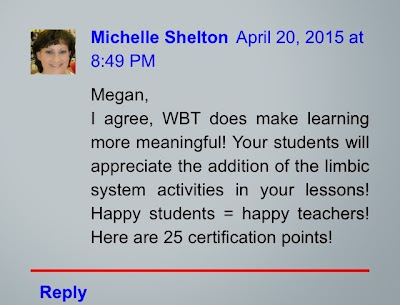
Reading chapter five was very interesting. I was surprised to learn that the brain has so many different parts, and that each of them has a different function. Thinking about my own teaching tendencies before Whole Brain Teaching, I would use a lot of hands-on games and activities to engage my students in lessons. I tried to make activities fun and interesting based on the objectives I was trying to get my students to master. Never did I think to specifically plan lessons that would address those brain areas which are supposed to be engaged in the learning process. I engaged the pre-frontal cortex because I had to obtain my student’s attention before beginning the lesson. Their motor cortex and visual cortex were engaged, most of the time, during the lessons which incorporate my student’s movement (gestures sometimes) and visual senses (modeling and anchor charts) to help make the lesson enjoyable.
I would have to say that the limbic system was the area that was neglected the most during my students lessons. After many failed attempts of trying to create lessons which the students would be excited about, I can see how the scorecard can generate these emotions for students. Learning the techniques used in Whole Brain Teaching, I can now more effectively engage my students in learning. The use of “powerpix” and “mirrors” allows my students to not just move during lessons, but use gestures as reminders of their learning through muscle memory. The Teach-Okay also allows them to gain the repetition needed to ensure maximum learning of the concepts being taught. These new methods are so exciting, and WBT has made learning in my classroom more meaningful.
Thinking about your own teaching tendencies, which brain areas are you most likely, and least likely, to activate in your students?
Reading chapter five was very interesting. I was surprised to learn that the brain has so many different parts, and that each of them has a different function. Thinking about my own teaching tendencies before Whole Brain Teaching, I would use a lot of hands-on games and activities to engage my students in lessons. I tried to make activities fun and interesting based on the objectives I was trying to get my students to master. Never did I think to specifically plan lessons that would address those brain areas which are supposed to be engaged in the learning process. I engaged the pre-frontal cortex because I had to obtain my student’s attention before beginning the lesson. Their motor cortex and visual cortex were engaged, most of the time, during the lessons which incorporate my student’s movement (gestures sometimes) and visual senses (modeling and anchor charts) to help make the lesson enjoyable.
I would have to say that the limbic system was the area that was neglected the most during my students lessons. After many failed attempts of trying to create lessons which the students would be excited about, I can see how the scorecard can generate these emotions for students. Learning the techniques used in Whole Brain Teaching, I can now more effectively engage my students in learning. The use of “powerpix” and “mirrors” allows my students to not just move during lessons, but use gestures as reminders of their learning through muscle memory. The Teach-Okay also allows them to gain the repetition needed to ensure maximum learning of the concepts being taught. These new methods are so exciting, and WBT has made learning in my classroom more meaningful.
Thursday, April 16, 2015
Ch 6 Assignment
Ch 6 assignment
Get ready for some quick WBT Certification Points! Invent 10 variations on class-yes! Received a BONUS 10 WBT CPs for 15 variations on class-yes!
1. Class 1+1 (or any addition problem) yes 2 (answer to addition problem)
2. Class 100-10 (or any subtraction problem) yes 90 (answer to any subtraction problem)
3. Class class 5 10 15 (skip counting) yes yes 20 25 30
4. Class class nouns yes yes person place thing (will have to train them with response)
5. Class class boy (any person) yes yes person
6. Class class toy (any thing) yes yes thing
7. Class class store (any place) yes yes place
8. Class class at (word families) yes yes hat (will have to teach the response wanted for word family)
9. Clase clase si si (we have a large Spanish population in our school)
10. Class class am yes yes am (sight word of the week)
11. Claaaassss quarter past yeeeessss 15
12. Claaaassss quarter till yeeeessss 45
13. Claaaassss half past yeeeesss 30
14. Class class puppy yes yes dog (any baby parent combination after science unit)
15. Class class desert yes yes camel
16. Class class mountains yes yes mountain goat
17. Class class ocean yes yes whale
18. Class class polar yes yes bear
19. Class class rainforest yes yes toucan
*The science, math, and grammar ones would be great for review of a topic.
Megan Sowers
80 WBT CP

Wednesday, April 15, 2015
Ch4 assignment
Imagine next year is completed. Using the system described in Chapter 4, you've faithfully charted your own behavior, as an instructor and your students’ progress. Looking back, what did you learn?
After attending a Whole Brain Teaching conference last year, I was sold and ready to implement it in my classroom. However, I knew I needed a plan to show improvement in my classroom. I decided to chart the progress of my students along with myself. It required work and discipline that paid off in the end. I learned a lot about myself as an education, and how implementing While Brain Teaching strategies affected my students' learning.
My primary goals for this past year were to be consistent in implementing WBT system, and to respond to challenging students controlling my tone. I used a 1-10 point system to evaluate myself. When I first began the evaluation system, I received a grade of 15 points for implementing WBT system, and 7 points for responding to challenging students while controlling my tone. That was not good enough for me. I was challenged to do better for myself as well as my students. I set an end goal of l8 points.
I also evaluated myself based on my students’ progress. I measured two things, smart choices and followed directions quickly.
I grouped my students into four groups (alphas, go-alongs, fence sitters, and challenging students). I made certain that my students were unaware of the grouping.
My Alpha group were my model students. They were the ones that followed directions quickly and made smart choices. I received 4 points for each Alpha in the group.
My Go-Along group were the students striving to be a model student, but did not always make smart choices. I received 3 points for each Go-Along.
My Fence Sitter group were students that struggled with consistency. This group was a daily challenge. I always put new students into this group. I received 2 points for each Fence Sitter.
My Challenging group was just that challenging. These students had constantly had trouble following directions quickly and making smart choices. It was nearly impossible at the beginning with these students, but I found that as I implemented the WBT system and responded to misbehavior quietly one-on-one, these students made progress. I gave myself 1 point for each challenging student.
I determined my average score by totaling the number of my points and then dividing by the number of students.
My groups all made really great progress. Most students were able to move up a group. I could see my points increase over the year. I’m believe that charting my progress, being consistent, and setting goals were the key factors. I feel my students and myself finished the year as winners.
After attending a Whole Brain Teaching conference last year, I was sold and ready to implement it in my classroom. However, I knew I needed a plan to show improvement in my classroom. I decided to chart the progress of my students along with myself. It required work and discipline that paid off in the end. I learned a lot about myself as an education, and how implementing While Brain Teaching strategies affected my students' learning.
My primary goals for this past year were to be consistent in implementing WBT system, and to respond to challenging students controlling my tone. I used a 1-10 point system to evaluate myself. When I first began the evaluation system, I received a grade of 15 points for implementing WBT system, and 7 points for responding to challenging students while controlling my tone. That was not good enough for me. I was challenged to do better for myself as well as my students. I set an end goal of l8 points.
I also evaluated myself based on my students’ progress. I measured two things, smart choices and followed directions quickly.
I grouped my students into four groups (alphas, go-alongs, fence sitters, and challenging students). I made certain that my students were unaware of the grouping.
My Alpha group were my model students. They were the ones that followed directions quickly and made smart choices. I received 4 points for each Alpha in the group.
My Go-Along group were the students striving to be a model student, but did not always make smart choices. I received 3 points for each Go-Along.
My Fence Sitter group were students that struggled with consistency. This group was a daily challenge. I always put new students into this group. I received 2 points for each Fence Sitter.
My Challenging group was just that challenging. These students had constantly had trouble following directions quickly and making smart choices. It was nearly impossible at the beginning with these students, but I found that as I implemented the WBT system and responded to misbehavior quietly one-on-one, these students made progress. I gave myself 1 point for each challenging student.
I determined my average score by totaling the number of my points and then dividing by the number of students.
My groups all made really great progress. Most students were able to move up a group. I could see my points increase over the year. I’m believe that charting my progress, being consistent, and setting goals were the key factors. I feel my students and myself finished the year as winners.
Circles and Cones lesson
This week we are talking about geometric shapes in math. My students enjoy and learn so much for more when using the Whole Brain Teaching PowerPix. I wanted to see how well it actually worked. So, I did an experiment with the circle and cone lesson. Yesterday, I taught the lesson as if I weren't using Whole Brain Teaching in my classroom. At the end of the lesson my students were confused, and they were unable to answer the questions on the worksheet. Today I taught the same exact concepts, but using the Whole Brain Teaching PowerPix for my lesson. After the lesson, my student's were able to complete the same worksheet from yesterday without any problems. I truly believe that the WBT system works. I have seen it in my own classroom which is made up of students from all backgrounds.
I videoed the lesson, and when I figure out how to post it. I will do so.
I videoed the lesson, and when I figure out how to post it. I will do so.
Monday, April 13, 2015
Ch 1-3 points
I was excited to see my certification points today. You either receive full credit - 25pts, partial credit - 10pts, or no points at all. I received full credit for both my ch1&2 assignment as well as my ch3 assignment.


I cannot wait to finish more of the chapter assignments to receive more points. Now I am happy to start signing posts with my name and CP total.
Mrs. Sowers
50 WBT CP
Saturday, April 11, 2015
Ch 3 assignment
Ch3
Pick two of the errors described in Chapter 3, pages 9-13, of "Whole Brain Teaching for Challenging Kids" and write yourself a letter of advice about how you're going to avoid these mistakes in the coming year. Include one or two useful quotes from the chapter.
Dear Self,
As you are finishing the last few weeks of the current school year and looking forward to next years class, I just wanted to give you two pieces of advice. Who better to give you advice than someone who knows you best, yourself. First, I want to remind you that your students are not your clones. You may want them to be the reading wiz, math answering, rule following, smart second grader you were, but you have to remember that not all students take things in the same way. Instead of telling students how to act, “invite students into your world; don't expect to find them already there.” Think of your students as pieces to a puzzle that have to work together to fit in a place rather than everyone being a “square peg fitting into a square hole.” Remember Whole Brain Teaching is a great way to invite students into the learning process while keeping control of your classroom at the same time.
Second, remember you are empowering students with knowledge that will last them a life time. The time you devote outside of school preparing lessons will provide your student’s with a greater chance of mastering the objective. Chris Biffle says, “Outstanding instruction involves huge, truly mountainous amounts of labor, preparing, practicing, researching, thinking through, refining instructional units.” You can continue to share lesson writing duties with your team, but just make sure you are preparing yourself for your classroom.
Continue to improve upon yourself as an educator because it will only make your student’s better in the long run.
Sincerely,
Megan Sowers
Pick two of the errors described in Chapter 3, pages 9-13, of "Whole Brain Teaching for Challenging Kids" and write yourself a letter of advice about how you're going to avoid these mistakes in the coming year. Include one or two useful quotes from the chapter.
Dear Self,
As you are finishing the last few weeks of the current school year and looking forward to next years class, I just wanted to give you two pieces of advice. Who better to give you advice than someone who knows you best, yourself. First, I want to remind you that your students are not your clones. You may want them to be the reading wiz, math answering, rule following, smart second grader you were, but you have to remember that not all students take things in the same way. Instead of telling students how to act, “invite students into your world; don't expect to find them already there.” Think of your students as pieces to a puzzle that have to work together to fit in a place rather than everyone being a “square peg fitting into a square hole.” Remember Whole Brain Teaching is a great way to invite students into the learning process while keeping control of your classroom at the same time.
Second, remember you are empowering students with knowledge that will last them a life time. The time you devote outside of school preparing lessons will provide your student’s with a greater chance of mastering the objective. Chris Biffle says, “Outstanding instruction involves huge, truly mountainous amounts of labor, preparing, practicing, researching, thinking through, refining instructional units.” You can continue to share lesson writing duties with your team, but just make sure you are preparing yourself for your classroom.
Continue to improve upon yourself as an educator because it will only make your student’s better in the long run.
Sincerely,
Megan Sowers
Ch 1 & 2 WBT assignment
One way to earn certification points is answers questions assigned to certain chapters in the book Whole Brain Teaching for Challenging Kids by Chris Biffle.
Ch 1&2 assignment
CoachB says ….."You've just been made principal of a charter school and you're about to address your staff for the first time. Select three points from chapters 1 and 2 that you are going to talk about describing key aspects of Whole Brain Teaching. Include one story about your teaching experience."
My answer
Good morning and welcome to a brand new school year! As we begin this new year, I know many of you are feeling anxiety, nervousness, and pure excitement. Those feelings are normal as I experienced those as a classroom teacher, and now as your new principal. We all look forward to new lessons and strategies that provide productive learning, enthusiasm for the content, and 100% student engagement. I want to share with you a way we can accomplish those three things with every lesson.
Early in my teaching career I was introduce to the Whole Brain Teaching system. I knew it was the perfect solution for my classroom in a high poverty school. Whole Brain Teaching brought classroom management using a scoreboard, super improver's wall, and five important rules. Also the student engagement was very visible with "teach-okay" and "mirror and words.” The students enjoyed learning new content with the Whole Brain Powerpix and Speed games.
Now your probably asking yourself, what makes it work? The answer is simple according to Chris Biffle, “if a student’s whole brain is involved in learning, there isn’t any mental area left over for challenging behavior.” I experienced this first hand in my own classroom. When I started using Whole Brain teaching, I went from having 50% student engagement and “Little Johnny” disrupting everyone in the room, to having 100% student engagement, and “Little Johnny” was no longer disrupting everyone because he was trying to earn a star on the Super Improver wall.
I’m encouraged with you as my staff that we can change the atmosphere of learning in our school. I’m encouraged by the sounds of teachers practicing “teach-okay” in the classrooms. I’m encouraged by the enthusiasm our students will have towards learning. I’m encouraged by the number of students we will empower with knowledge. I am encouraged by you, and I want you to be encouraged by the change Whole Brain Teaching will bring to our school.
Let me leave you with these last words as I hope I have not done this to you. Chirs Biffle says the First Great Law of Whole Brain Teaching is “the longer we talk, the more students we lose.”
Ch 1&2 assignment
CoachB says ….."You've just been made principal of a charter school and you're about to address your staff for the first time. Select three points from chapters 1 and 2 that you are going to talk about describing key aspects of Whole Brain Teaching. Include one story about your teaching experience."
My answer
Good morning and welcome to a brand new school year! As we begin this new year, I know many of you are feeling anxiety, nervousness, and pure excitement. Those feelings are normal as I experienced those as a classroom teacher, and now as your new principal. We all look forward to new lessons and strategies that provide productive learning, enthusiasm for the content, and 100% student engagement. I want to share with you a way we can accomplish those three things with every lesson.
Early in my teaching career I was introduce to the Whole Brain Teaching system. I knew it was the perfect solution for my classroom in a high poverty school. Whole Brain Teaching brought classroom management using a scoreboard, super improver's wall, and five important rules. Also the student engagement was very visible with "teach-okay" and "mirror and words.” The students enjoyed learning new content with the Whole Brain Powerpix and Speed games.
Now your probably asking yourself, what makes it work? The answer is simple according to Chris Biffle, “if a student’s whole brain is involved in learning, there isn’t any mental area left over for challenging behavior.” I experienced this first hand in my own classroom. When I started using Whole Brain teaching, I went from having 50% student engagement and “Little Johnny” disrupting everyone in the room, to having 100% student engagement, and “Little Johnny” was no longer disrupting everyone because he was trying to earn a star on the Super Improver wall.
I’m encouraged with you as my staff that we can change the atmosphere of learning in our school. I’m encouraged by the sounds of teachers practicing “teach-okay” in the classrooms. I’m encouraged by the enthusiasm our students will have towards learning. I’m encouraged by the number of students we will empower with knowledge. I am encouraged by you, and I want you to be encouraged by the change Whole Brain Teaching will bring to our school.
Let me leave you with these last words as I hope I have not done this to you. Chirs Biffle says the First Great Law of Whole Brain Teaching is “the longer we talk, the more students we lose.”
Subscribe to:
Posts (Atom)